BOX4TECH

Search

Total Pageviews

Showing posts with label Robotic. Show all posts

Sunday, February 20, 2011

DARPA's Brain-Controlled Robotic Arm Fast-Tracked, Could Be Available in Just Four Years

 
 Usually when we report on DARPA’s robotic, brain-controlled prosthetic arm, we’re reporting on news from the lab. Soon we’ll be reporting from clinical trials. On Tuesday the Food and Drug Administration said it would fast-track the DARPA device, pushing it through the approval process with priority assistance in order to get it to amputees—many of which are returning from combat zones—as soon as four years from now.
There are really two headlines here; first, the DARPA arm is a modern marvel that’s taken several years, $100 million, and some of the best minds in prosthetics design, robotics, and brain-machine interfaces to develop. It marks a technological leap—a prosthetic arm that is robotically controlled via a chip in the brain, making it more like a real limb than any approved prosthesis before it.
We expect the well-funded blue-sky thinkers at DARPA to identify a problem—in this case, the large numbers of American service members returning from Iraq and Afghanistan with limbs severed by IEDs—and quickly turn around a technological solution. We expect the exact opposite from the FDA. But long viewed as a place where innovation goes to die, the FDA is attempting to remake itself into a bureaucracy capable of moving innovative technologies from lab to market faster (that’s the second headline).
In the FDA’s defense, its job is not easy. Applicants bring the agency technologies and drugs never seen previously in the history of the world and ask scientists there to assess them for safety—a difficult job to say the least. The fast-track review—a new initiative that aims to bring technologies or drugs considered most important to market faster—will offer companies or agencies an FDA case manager to cut down on bureaucratic snafus and will give those products priority access to senior agency scientists in hopes of cutting the period of t review in half.
For DARPA’s arm, that means four or five years rather than a decade spent in the FDA approval pipeline. Within six months DARPA will begin implanting chips in five patients’ heads to begin clinical trials. Those patients will be monitored for a year to see if chip function degrades or if bodies reject the chips. If the trials are successful, that four or five year timeline for commercial availability is realistic.
Now if only DARPA could create a tool that cuts through red tape.

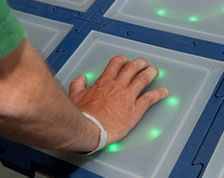
The Robotic Therapy Tiles

Tiles have been seen as decorative elements for millennia, even back when the Egyptians and the Assyrians used to manufacture their own tiles. Later on, as people learnt how to develop this industry from mere decorative into practical and decorative elements, used for floors, walls, roofs, etc. people have given new destinations to tiles, according to the needs on the market. Although marble, granite, ceramic tiles, etc are incredibly beautiful and are able to give a house both a classical and a modern look, not to mention that cleaning them becomes a real pleasure, the society has taken this concept to the next level.
As the needs on the market have become more and more varied, the manufacturers came up with a new product: the robotic therapy tiles. These tiles have been created unto a medical purpose, in order to help people recover from surgeries, to help them use their arms, legs, etc again. Therefore, they function as miniature artificial intelligence designed to create all sorts of games to stimulate the use of force in legs and arms. As people step on them or push them with their hands, the tiles provide a feedback on the force used, informing the patient he needs to press or step harder.
Furthermore, the therapy tiles have been developed into games that make the recovery not only useful, but pleasant, too. For example, several persons using the therapy tiles may compete together and see who manages to get the best feedback from the little "robot". They thus may forget they are undergoing a medical procedure, but perceive this process simply as a mere competitive game, that makes recovery easier and more fun.
Such a practice is most useful especially for patients who have been released from hospital, as the playware is extremely easy to use and easy to set. Therefore, after the therapy in hospital, you can take your tiles home, invite some friends over and have fun recovering from an injured leg or arm.
All in all, tiles are not only beautiful artifacts that one can use home in order to embellish it or to make it warmer or cozier, but they are therapy instruments that are not only healthy, but fun, too. Therefore, the concept of tiles has been given a new meaning.
The marble tiles are suited for most houses, both traditional and contemporary, as they are very beautiful and extremely easy to maintain.

Blog Archive