BOX4TECH

Search

Total Pageviews

Showing posts with label nasa. Show all posts

Thursday, March 10, 2011

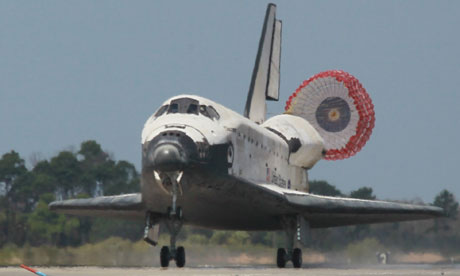
Space shuttle Discovery landing marks beginning of the end

The space shuttle Discovery lands at Kennedy Space Centre after returning for the last time from space. Photograph: Joe Raedle/Getty Images
The space shuttle Discovery has ended its career as the world's most flown spaceship, returning from orbit for the last time and taking off in a new direction as a museum piece.
After a flawless trip to the International Space Station, Nasa's oldest shuttle swooped through a few wispy clouds on its way to its final touchdown.
"To the ship that has led the way time and time again, we say, 'Farewell Discovery'," declared Mission Control commentator Josh Byerly.
When it landed three minutes before noon EST (5pm GMT), Discovery ceased being a reusable spaceship.
"For the final time: wheels stop," commander Steven Lindsey called out when the shuttle rolled to a stop. He was the last of the six crew members to climb out of the shuttle.
Dozens of Nasa officials – flight directors, launch managers, former astronauts – joined the crew on the runway to admire the shuttle and pose for pictures.
"It's a pretty bittersweet moment for all of us," Lindsey said. "As the minutes pass, I'm actually getting sadder and sadder about this being the last flight."
Even after shuttles Endeavour and Atlantis make their final voyages in the coming months, Discovery will still hold the all-time record with 39 missions, 148 million miles (238 million kilometres), 5,830 orbits of Earth, and 365 days spent in space. All that was achieved in under 27 years.
Discovery now leads the way to retirement as Nasa winds down the 30-year shuttle programme in favour of interplanetary travel.
Nasa estimates it will take several months of work – removing the three main engines and draining all hazardous fuels – before Discovery is ready to head to the Smithsonian Institution. It will make the 750m (1,200km) journey strapped to the top of a jumbo jet.
Throughout the flight, Lindsey and his crew marvelled at how well Discovery was performing. They noted that the spacecraft was going into retirement still "at the top of her game".
Discovery's last mission unfolded smoothly despite a four-month grounding for fuel tank repairs and a liftoff on 24 February in the last two seconds of the countdown.
"It came back as perfect on its final flight as it did on its first flight," Lindsey said.
Perhaps more than any other shuttle, Discovery consistently delivered.
It made its debut in 1984 following shuttles Columbia and Challenger, dispatched the Hubble Space Telescope in 1990, flew the first shuttle rendezvous to Russia's Mir space station and carried the first female shuttle pilot in 1995, and gave another ride into space to John Glenn, the first American to orbit the Earth, in 1998.
It got Nasa flying again, in 1988 and 2005, following the Challenger and Columbia disasters. And it flew 13 times to the space station, more than any other craft. On its last trip, it delivered a new storage compartment packed with supplies and a humanoid robot.
"You're sad to see her be retired, but at the same time, it's really a pride thing. We got her back OK. It was a beautiful mission," said Ken Smith, a Boeing propulsion manager who monitored the shuttle's systems from the landing strip.
But he added: "We've got two more to fly."
The Discovery astronauts took several minutes to go through the long receiving line on the runway. Nasa's boss, Charles Bolden, a former shuttle commander who twice flew Discovery, led the welcoming party and called it "an absolutely incredible flight." Earlier in the morning, he joined about 50 local eighth-graders eager to see history in the making.
Bolden will announce the final homes for Endeavour and Atlantis on 12 April – 30 years to the day that Columbia soared on the first shuttle flight.
Nasa planned to move Endeavour out to the launch pad Wednesday night for its 19 April liftoff, but delayed the trip until Thursday because bad weather was expected. The mission will be commanded by Mark Kelly, the husband of Gabrielle Giffords the US congresswoman who was shot and wounded in Arizona. His identical twin brother Scott is currently the skipper of the space station; he returns to Earth next week on a Russian Soyuz spacecraft.
Atlantis is slated to make its last trip at the end of June.
Nasa is under presidential direction to spread its wings beyond low-Earth orbit. The goal is to send astronauts to an asteroid and then Mars in the decades ahead. There is not enough money for Nasa to achieve that and maintain the shuttle programme at the same time. As a result, the shuttles will stop flying this summer after 30 years.
American astronauts will keep hitching rides to the space station on Russian capsules, until private companies are able to provide a taxi service to and from orbit. Nasa expects to get another nine years out of the space station.

Thursday, March 3, 2011

Astronauts get to relax after 2 spacewalks

In this image provided by NASA the Italian-built Permanent Multipurpose Module in the grasp of the International Space Station's Canadarm2 is being transferred from space shuttle Discovery's payload bay to be permanently attached to the Earth-facing port of the station's Unity node Tuesday March 1, 2011. (AP Photo/NASA)

The Associated Press
Date: Thursday Mar. 3, 2011 6:29 AM ET
CAPE CANAVERAL, Fla. — The astronauts in orbit at the International Space Station are getting a break.
The two crews of the linked space shuttle and space station will get some precious time off Thursday afternoon. NASA officials say it's well deserved, following Wednesday's successful spacewalk.
Before relaxing, the astronauts will work on an air purifier aboard the space station.
Discovery will remain at the International Space Station until Sunday. That's a day longer than originally planned. Mission managers want the shuttle crew to help unload the newly installed storage unit. There's a possibility the astronauts may get yet another bonus day in orbit, which would stretch their mission to 13 days.
It's the final voyage for NASA's oldest shuttle.

Source:  www.ctv.ca

Wednesday, March 2, 2011

Discovery Astronauts Gear Up for Second Spacewalk

Two astronauts will venture outside the International Space Station Wednesday on the last spacewalk of their mission, this time to perform some leftover maintenance work.
Discovery shuttle astronauts Steve Bowen and Alvin Drew are slated to don their bulky NASA-issue spacesuits and float outside of the station's Quest airlock at 10:18 a.m. EST (1518 GMT). It's the second and final spacewalk of the mission – Discovery's last spaceflight before being retired.
To distinguish themselves for NASA cameras, Bowen will wear a spacesuit with red stripes while Drew will wear a solid white spacesuit. The excursion is expected to last approximately 6 1/2 hours.
Bowen and Drew successfully completed their mission's first spacewalk on Monday (Feb. 28) to install a power extension cable and move a faulty cooling pump module from a temporary attachment bracket to a storage platform on the station's exterior.
For today's outing, one of the major tasks will be to vent about 10 pounds of residual ammonia from inside the defunct cooling pump. The ammonia pump broke down in the summer, and was replaced during a series of emergency spacewalks conducted by two space station astronauts during a previous spacewalk. [Inside and Out: The International Space Station] Read more...
Source: www.guardian.co.uk

Tuesday, March 1, 2011

Space station getting extra storage room

In this Feb 26, 2011 NASA image photographed by an Expedition 26 crew member, the space shuttle Discovery is seen against a cloud-covered part of Earth. (AP Photo/NASA)
The Associated Press
Date: Tuesday Mar. 1, 2011 6:42 AM ET
CAPE CANAVERAL, Fla. — The International Space Station is getting an extra storage room.
Space shuttle Discovery delivered the new compartment over the weekend.
The orbiting astronauts will install the 21-foot-long chamber Tuesday morning. It's loaded with supplies as well as a humanoid robot that will be tested as a potential astronaut helper.
The Italian-built chamber is named Leonardo, after Leonardo da Vinci. It flew seven times to the space station as a temporary cargo carrier. This time, it's staying.
Discovery's last flight will last an extra day. Mission Control radioed up the news following Monday's spacewalk. The 12-day mission will now end next Tuesday. Once Discovery lands, it will be retired and put in a museum.


Friday, February 25, 2011

NASA to "Reach for New Heights"

 Look at this video and comment it!!
With the President's Fiscal Year 2012 Budget proposal, NASA will continue leading a quest to win the future and help the nation innovate, educate and build by working to protect Earth, uncover distant worlds, and expand the frontiers of technology.


Source: , http://www.youtube.com/watch?v=cmOiW_JbXMc

Thursday, February 24, 2011

Space shuttle Discovery fueled for final flight

CAPE CANAVERAL, Fla. (AP) — NASA's most traveled space shuttle, Discovery, was fueled for an afternoon liftoff Thursday on its final voyage after nearly three decades of service.
NASA began pumping hundreds of thousands of gallons of fuel into Discovery shortly after sunrise, as the six astronauts assigned to the space station delivery mission sat down for breakfast at crew quarters. It was their second stab at this. November's launch attempt never made it past fueling.
Launch manager Mike Moses said everything finally looked to be coming together and noted it was a good day to give it a good shot. Even the weather was looking up: the forecast improved to 90 percent "go" for the 4:50 p.m. liftoff.
This time, NASA was confident no hydrogen gas would leak and no cracks would develop in the external fuel tank. Both problems cropped up during the initial countdown in November, and the repairs took almost four months. The cracks in the midsection of the tank, which holds instruments but no fuel, could have been dangerous.
Discovery will head to the International Space Station with the crew, as well as a load of supplies and a humanoid robot.
This will be the 39th flight for Discovery, set to become the first of the three surviving space shuttles to be retired this year and sent to a museum. It has since logged 143 million miles since its first flight in 1984.
NASA expects 40,000 guests on hand for Discovery's farewell launch, including a small contingent from Congress. Watching with special interest from Mission Control in Houston will be astronaut Timothy Kopra, who was supposed to be the flight's lead spacewalker. He was hurt in a bicycle crash last month and was replaced by Stephen Bowen, who will become the first astronaut to fly back-to-back shuttle missions.
Well before dawn, recreational vehicles lined nearby roads offering the best views of liftoff. Signs outside businesses and government offices in the neighboring towns of Cape Canaveral and Cocoa Beach offered words of encouragement. "The heavens await Discovery," one church proclaimed. Local grocery stores stocked up on extra red, white and blue cakes adorned with shuttle pictures.
Launch director Mike Leinbach noted that it would be bittersweet to see Discovery soar one last time. It will be even tougher to see the oldest surviving shuttle land, he said.
"The emotion will really hit on the runway after the mission is complete," Leinbach told reporters on the eve of launch.
Discovery will spend 11 days in orbit — on top of the 352 days it's already spent circling the planet — and will rack up another 4.5 million miles.
Its list of achievements include delivering the Hubble Space Telescope to orbit, carrying the first Russian cosmonaut to launch on a U.S. spaceship, returning Mercury astronaut John Glenn to orbit, and bringing shuttle flights back to life after the Challenger and Columbia accidents.
"She's been an amazing machine," Leinbach said. "She's done everything we've asked of her."
Heading up Discovery's veteran crew is retired Air Force Col. Steven Lindsey. Two of his crew actually lived on the space station in 2009. During the 11-day flight, they will deliver and install a closet-like compartment full of space station supplies — made in Italy and named Leonardo for il Signor da Vinci.
Packed inside the compartment is Robonaut 2, or R2, set to become the first humanoid robot in space. The experimental machine — looking human from the waist up — will remain boxed until after Discovery departs.
Up at the space station, meanwhile, the six-person crew got ready to receive a European cargo ship launched last week from French Guiana. It was due to dock at midmorning, and launch officials were keeping abreast of the events unfolding 220 miles up. A smooth hookup would clear Discovery for launch.
NASA is under presidential direction to retire the shuttle fleet this summer, let private companies take over trips to orbit and focus on getting astronauts to asteroids and Mars. There's been considerable disagreement among lawmakers and the space community on how best to accomplish this.
"Godspeed Discovery," retired space shuttle program manager Wayne Hale said in a Twitter update Thursday. "Prayers for a safe flight and wisdom for decision makers."

NASA delays launch of Glory Earth observation satellite

Science workers monitor a crane lifting NASA's Glory satellite's upper stack for attachment onto the Taurus XL rocket at Vandenberg Air Force Base in California. Source: AP


NASA has delayed the launch of the Glory Earth observation satellite until tomorrow, due to a glitch less than 15 minutes before it was to be launched today atop a four stage Taurus-XL rocket. NASA said an unexpected reading in a ground control interface with the launcher prompted the postponement, initially for 24 hours and then until tomorrow at 9.09pm (AEDT).
"Engineers from NASA and Orbital Sciences Corp. continue to troubleshoot a technical issue that arose during Wednesday's initial launch attempt," the space agency said in a statement.
"The target launch date also will ensure personnel get the required rest before entering another countdown," it added.
Data from the Glory mission will allow scientists to better understand how the sun and tiny atmospheric particles called "aerosols" affect Earth's climate and how they may affect human life.

Source: www.theaustralian.com

Tuesday, February 22, 2011

NASA Releases Images Of Man-Made Crater On Comet

 PASADENA, Calif. — NASA’s Stardust spacecraft returned new images of a comet showing a scar resulting from the 2005 Deep Impact mission. The images also showed the comet has a fragile and weak nucleus.
The spacecraft made its closest approach to comet Tempel 1 on Monday, Feb. 14, at 8:40 p.m. PST at a distance of approximately 111 miles. Stardust took 72 high-resolution images of the comet. It also accumulated 468 kilobytes of data about the dust in its coma, the cloud that is a comet’s atmosphere. The craft is on its second mission of exploration called Stardust-NExT, having completed its prime mission collecting cometary particles and returning them to Earth in 2006.
The Stardust-NExT mission met its goals which included observing surface features that changed in areas previously seen during the 2005 Deep Impact mission; imaging new terrain; and viewing the crater generated when the 2005 mission propelled an impactor at the comet.
“This mission is 100 percent successful,” said Joe Veverka, Stardust-NExT principal investigator of Cornell University, Ithaca, N.Y. “We saw a lot of new things that we didn’t expect, and we’ll be working hard to figure out what Tempel 1 is trying to tell us.”
Several of the images provide tantalizing clues to the result of the Deep Impact mission’s collision with Tempel 1.
“We see a crater with a small mound in the center, and it appears that some of the ejecta went up and came right back down,” said Pete Schultz of Brown University, Providence, R.I. “This tells us this cometary nucleus is fragile and weak based on how subdued the crater is we see today.”
Engineering telemetry downlinked after closest approach indicates the spacecraft flew through waves of disintegrating cometary particles including a dozen impacts that penetrated more than one layer of its protective shielding.
“The data indicate Stardust went through something similar to a B-17 bomber flying through flak in World War II,” said Don Brownlee, Stardust-NExT co-investigator from the University of Washington in Seattle. “Instead of having a little stream of uniform particles coming out, they apparently came out in chunks and crumbled.”
While the Valentine’s Day night encounter of Tempel 1 is complete, the spacecraft will continue to look at its latest cometary obsession from afar.
“This spacecraft has logged over 3.5 billion miles since launch, and while its last close encounter is complete, its mission of discovery is not,” said Tim Larson, Stardust-NExT project manager at JPL. “We’ll continue imaging the comet as long as the science team can gain useful information, and then Stardust will get its well-deserved rest.”
Stardust-NExT is a low-cost mission that is expanding the investigation of comet Tempel 1 initiated by the Deep Impact spacecraft. The mission is managed by JPL for NASA’s Science Mission Directorate in Washington. Lockheed Martin Space Systems in Denver built the spacecraft and manages day-to-day mission operations.
The latest Stardust-Next/Tempel 1 images are online at:
http://www.nasa.gov/mission_pages/stardust/multimedia/gallery-index.html
For more information about Stardust-NExT, visit:
http://stardustnext.jpl.nasa.gov

Blog Archive