BOX4TECH

Search

Total Pageviews

Showing posts with label Technology. Show all posts

Saturday, February 26, 2011

Peripheral makers get ready for Thunderbolt

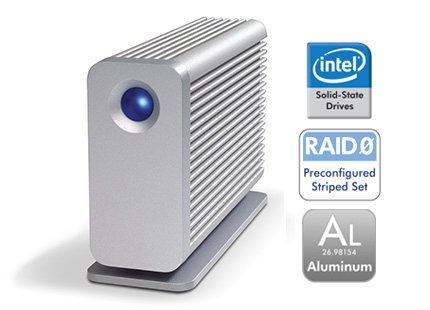
The arrival of Apple’s latest MacBook Pro models brings a brand new peripheral-connection technology from Intel—Thunderbolt—and with it the promise of faster data transfer speeds. But if Thunderbolt’s going to deliver on that promise, peripheral makers will need to deliver products that take advantage of that technology.
A smattering of companies have already unveiled products aimed at making the most of Thunderbolt. A few other that Macworld spoke to aren’t revealing their plans just yet, though they did express interest in what the new technology has to offer.
To review, Intel developed Thunderbolt in conjunction with Apple. The connectivity technology will transfer data between host devices and external devices at speeds of up to 10Gbps. At that speed, you could transfer a full-length high-definition movie from an external storage device to your Mac in less than 30 seconds.
With Thunderbolt ports included in all new MacBook Pro models, the technology will soon be in the hands of consumers worldwide. And in a few cases, they won’t have to wait too long for Thunderbolt-ready peripherals.
Intel and Apple had barely broken the news of Thunderbolt’s arrival Thursday when RAID storage supplier Promise Technology announced its own plans for the connectivity standard. The company praised Thunderbolt’s speed and “amazing flexibility for connectivity to high-performance peripherals” when announcing its own Thunderbolt-compatible high performance hardware RAID offering, Pegasus. Set for release in the second quarter of 2011 and designed for media and entertainment customers, Pegasus will feature two Thunderbolt ports and will be available in 4-bay and 6-bay aluminum enclosures with up to 12TB of storage.
“Once we were approached [by Intel] about this, it was a no-brainer,” Promise product manager Billy Harrison told Macworld. “The performance, with 10 Gigabits, dual channel, bidirectional…that’s extremely appealing.”  Read more...


Sunday, February 20, 2011

Help Buy a Satellite from a Bankrupt Telecom to Beam Free Web to the Developing World

Increasing web connectivity in the developing world has been a focus of philanthropists, international bodies like the U.N., and individual states alike. But, like most grand visions, wiring entire countries for the Web is expensive. So how does a philanthropist sidestep the massive expense of building and launching a satellite that can beam Internet to remote regions of the world? You wait for a company to go bankrupt, then you buy their brand new communications satellite already in orbit on the cheap.
At least, that’s the idea. A philanthropic group called Ahumanright.org (universal Internet is that human right) has launched a site called “Buy This Satellite” that aims to raise $150,000 to bid for Terrastar-1, a school-bus-sized satellite launched in 2008. Terrastar-1 is currently in orbital limbo, so to speak, after its owner filed for bankruptcy. The group will also invest in the development of an open source, low cost modem for use in the developing world.
Once acquired, the group hopes to park the satellite over a developing country or countries--Papua New Guinea, the site points out, has an open orbital slot and only 2.1 percent of its population is online--and allow its citizens access to the Web for free. That, theoretically, will help educate the population, open up new avenues for commerce, and otherwise provide lagging economies with all the technological advantages offered to the wired world.
There are plenty of aspects of the plan that seem easy to poke holes in. For one, satellites generally go for more than $150,000 (even at a bankruptcy auction). And the phase one plan calls for hiring several full-time engineers for the project, but that'll cost $50,000 per year per engineer (and that's only if the engineers are content to work on the cheap)--well, you can see why we might be a bit skeptical.
However, the notion is both noble and ambitious, and we’re all about nobility and ambition. If the money can be found, a project like this has the power to seriously affect change in places where connectivity is scarce (if it’s available at all). Go to buythissatellite.org to do your part to purchase

Robonaut 2 Sentenced to Additional Month In Crate

NASA has just announced it will postpone the 39th and final launch of space shuttle Discovery until November 30 at the earliest, after a hydrogen gas leak stalled this afternoon’s scheduled liftoff.
Meanwhile, Robonaut, who was supposed to start his career as the first humanoid robot in space this week, remains shut in his custom SLEEPR crate while the shuttle sorts out its problems.
Technicians assessing the leak found in an external fuel tank this morning also discovered a foam crack on the tank’s liquid oxygen intertank flange, prompting NASA to delay the launch so they can fix the damage and assess possible causes.
Since November 8 marks the end of this window of acceptable solar angles amenable to Discovery's launch, NASA must wait until the next launch window, from November 30 through December 5, to begin the 11-day mission.


Robonaut 2, Prepared for Launch with Protective Koozies in Place, Waits for Discovery To Get Its Act Together Photo courtesy of NASA

Blog Archive